
BRMill Sustainability:
From Root to Result
BRMill Sustainability:
From Root to Result
At BRMill, sustainability is not just a concept; it's a pillar that guides all our operations, from seed selection to exporting to the world's most demanding markets.
We cultivate quality and trust at every stage, ensuring corn products that meet not only the highest food standards, but also the criteria of environmental and social responsibility.
Our operation integrates agricultural production and industry on the same property, Fazenda São Miguel, in Silvânia – GO. This allows us absolute control over each stage, from planting to processing, resulting in logistical efficiency and total transparency.

Quality and Traceability
Certified
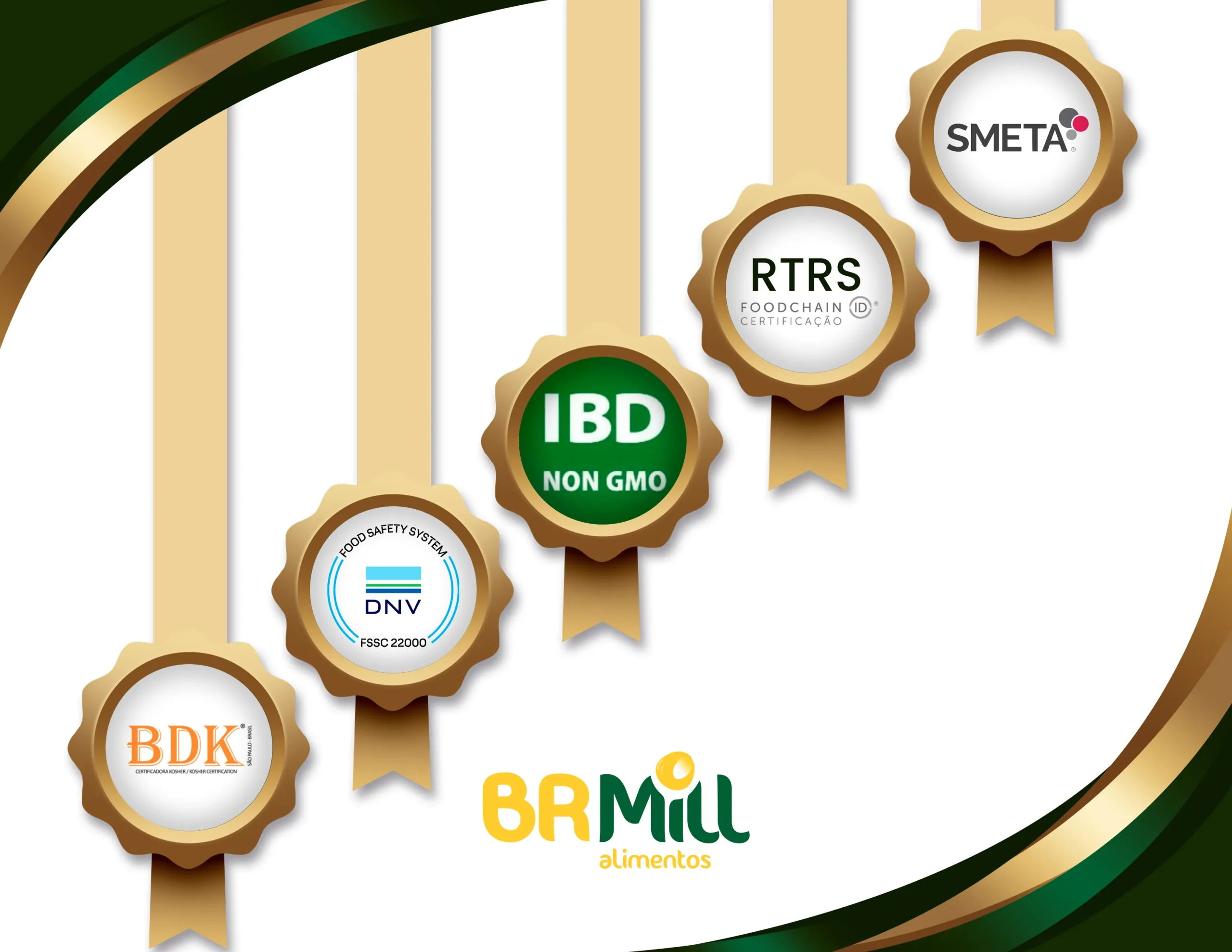
We offer non-GMO corn., with full traceability and guaranteed by prestigious international certifications..
These seals recognize our good practices., reinforce the sustainable value of BRMill products. and expand our opportunities in the global market.

IBD NON-GMO
This confirms that our production complies with non-GMO product standards for a wide range of corn products.
RTRS
An international seal that recognizes our good agricultural practices, complete traceability, respect for the environment and people, and consistency in quality. Fazenda São Miguel has received this certification.
Kosher
Our corn products, including cornmeal, grits, hominy, flakes, and germ, are certified Kosher in the "Parve" classification.
FSSC 22000
A rigorous food safety management system ensures that our processes and products meet the highest global standards.
SMETA
This demonstrates our commitment to workers' rights, health and safety, the environment, and ethical business practices, reinforcing our dedication to business sustainability.
For our large-scale corn customers, these certifications are a guarantee of receiving reliable raw materials, produced responsibly and ready to meet the most demanding markets in the world.

Environmental Impact and Regenerative Agriculture:
Cultivating a Better Future
Environmental Impact and Regenerative Agriculture:
Cultivating a Better Future
We are at the forefront of regenerative agriculture, with a clear commitment to preserving the soil, respecting natural cycles, and mitigating environmental impacts.
In partnership with Nestlé and the consulting firm Agrobiota, we are implementing and monitoring advanced environmental practices at the São Miguel and Aliança farms in Goiás, aligned with Nestlé's global net-zero emissions goals by 2050.

Our regenerative practices include:
Crop Rotation and Cover Crops:
We adjusted crop diversification to improve soil health and biodiversity. We rotated corn, soybeans, wheat, and white oats, using Brachiaria ruziziensis and millet as cover crops, intercropped Brachiaria ruziziensis with corn, and plan to introduce a cover crop mix in 2025.
Efficient Use of Nitrogen:
We replaced conventional fertilizers with stabilized or slow/controlled-release fertilizers, following the 4R concept (right source, right dose, right time, right place). This reduces nitrogen volatilization and greenhouse gas (GHG) emissions.
Bio-inputs and Soil Improvement:
Although large-scale organic fertilization is a logistical challenge, we have implemented the use of bio-inputs (such as Korin's Bokashi and Biotrop products) to increase microbial activity, biological nitrogen fixation, and plant resilience, contributing to soil organic matter.
Integrated Pest Management (IPM):
A system that allows the use of pesticides only when strictly necessary, at the appropriate dose and time, promoting biodiversity and soil health.
Direct Planting System (DPS):
Adopted on our farms since 1989, this system avoids tilling the soil, maintains permanent cover, and diversifies crops, resulting in improved soil health and reduced erosion.
Tree Planting:
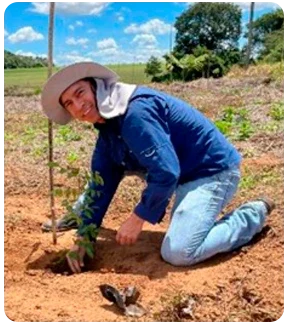
To regenerate degraded areas, protect water resources and increase biodiversity, contributing to long-term carbon sequestration. More than 1,600 native Cerrado trees were planted on the Aliança and São Miguel farms in 2024.
Crop Rotation and Cover Crops:
We adjusted crop diversification to improve soil health and biodiversity. At Fazenda Aliança, we rotate corn, soybeans, wheat, and white oats, using Brachiaria ruziziensis and millet as cover crops. At Fazenda São Miguel, we use Brachiaria ruziziensis intercropped with corn and plan to introduce a cover crop mix in 2025.
Efficient Use of Nitrogen:
We replaced conventional fertilizers with stabilized or slow/controlled-release fertilizers, following the 4R concept (right source, right dose, right time, right place). This reduces nitrogen volatilization and greenhouse gas (GHG) emissions.
Bio-inputs and Soil Improvement:
Although large-scale organic fertilization is a logistical challenge, we have implemented the use of bio-inputs (such as Korin's Bokashi and Biotrop products) to increase microbial activity, biological nitrogen fixation, and plant resilience, contributing to soil organic matter.
Integrated Pest Management (IPM):
A system that allows the use of pesticides only when strictly necessary, at the appropriate dose and time, promoting biodiversity and soil health.
Direct Planting System (DPS):
Adopted on our farms since 1989, this system avoids tilling the soil, maintains permanent cover, and diversifies crops, resulting in improved soil health and reduced erosion.
Tree Planting:
To regenerate degraded areas, protect water resources and increase biodiversity, contributing to long-term carbon sequestration. More than 1,600 native Cerrado trees were planted on the Aliança and São Miguel farms in 2024.
Results of Regenerative Agriculture
Our project is already showing measurable impacts on emissions, soil health, and regenerative maturity.
GHG Reduction
Source: Internal GHG inventory (2023–2024).
GHG Reduction
Source: Internal GHG inventory (2022–2024).
“"Healthy soil / high quality"”
Physicochemical analyses and BioAS (Embrapa) indicate healthy/high quality soil on the farms, with increase in organic matter, confirming the effect of regenerative practices.
Source: soil reports (BioAS/Embrapa).
“Advanced” Category (2024)
- Aliança Farm evolved into Advanced in 2024.
- São Miguel Farm evolved into Advanced in 2024.
The evolution in FAT reflects gains in carbon stocks and efficiency in the use of inputs.
At BRMill, we believe that sustainability is the key to long-term success. By choosing our products, you guarantee superior quality and align yourself with a supply chain that prioritizes... planet's health and the people's well-being.